千窑难得一宝 · A Thousand Kilns for One Treasure
The most technically demanding colour in Chinese ceramics.
Copper oxide, a ten-degree firing window, and a thousand years of kiln failure.
In the entire history of Chinese high-fire ceramics, no colour has been more difficult to achieve or more prized when achieved than the deep, clear red of 釉里红 (underglaze red). The Chinese saying is exact: 千窑难得一宝 — "a thousand kilns for one treasure." It is not hyperbole. The copper oxide that produces underglaze red is chemically sensitive to temperature within a window of approximately ten degrees Celsius. Too high, and the copper volatilises entirely — the pattern disappears, leaving a ghost of grey-white. Too low, and the copper fails to fully reduce, producing a muddy blackish-grey. The bright ruby red that collectors prize exists only in the narrow middle: found, not made.
This physical difficulty has defined the tradition's history: periods of success tied to exceptional kilnmasters, periods of abandonment when the technical knowledge was lost, and a final resolution only in the Qing dynasty when consistent high-quality firing became possible. Understanding underglaze red is understanding the limit of what a kiln can be asked to do.
Cobalt on white. Stable, reproducible, globally traded. The foundation of Jingdezhen.
Copper on white. Thousand kilns, one treasure. The rarest high-fire colour. This guide.
Underglaze blue outlines, overglaze enamel fills. Ming Chenghua — the rarest formula.
Opaque pink enamels. Qing Yongzheng / Qianlong. The auction market's summit.
Five-colour overglaze. Ming Jiajing / Wanli. Bold and vivid energy.
Fire, metal oxide, restraint. From Ming sacrificial red to Qing peachbloom. One colour, one fire.
"千窑难得一宝。"
— The definitive Chinese assessment of underglaze red: "A thousand kilns for one treasure." This is not a figure of speech — it is a technical description. For most of Chinese ceramic history, a kiln firing underglaze red expected the overwhelming majority of pieces to fail. The few that emerged with clear, bright ruby colour were, and remain, among the most prized objects in Chinese decorative art.The history of underglaze red is a story of discovery, loss, partial recovery, and final mastery — spanning eight centuries from the first accidental copper-red flashes in Tang kilns to the controlled, jewel-bright productions of Qing Yongzheng. No other Chinese ceramic tradition has such a discontinuous history, and that discontinuity is directly explained by the copper oxide chemistry at its core.
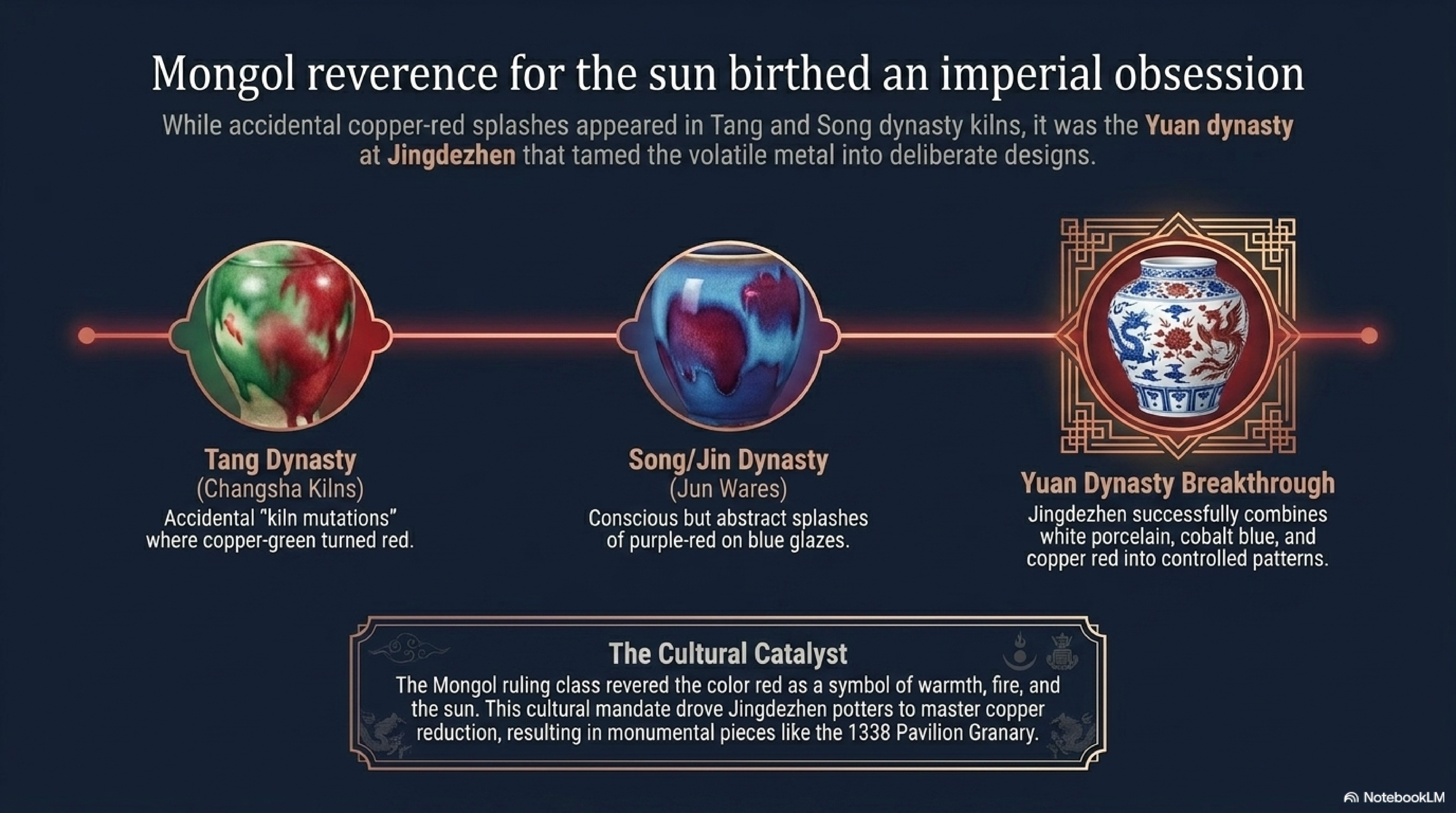
The arc of underglaze red. Tang Changsha kiln: copper glazes occasionally produced red flashes — accidental, not deliberate. Yuan Jingdezhen: deliberate creation of mature underglaze red, contemporary with the blue and white breakthrough. Ming Hongwu–Xuande: the first peak, including the legendary Xuande "ruby red" (宝石红). Ming mid-period: technical interruption — loss of the key raw material (鲜红土), replaced by low-temperature alum red (矾红). Qing Kangxi–Yongzheng: full recovery and summit — controlled, reproducible, jewel-like.
Accidental origins. Copper-bearing glazes at Changsha kiln occasionally reduced to produce patches of red — a kiln accident rather than a deliberate technique. The conditions that produced it were not understood or controlled.
Deliberate creation. Jingdezhen introduces mature underglaze red, contemporaneous with blue and white. Firing atmosphere difficult to control in the large wood-fired dragon kilns; colour often unstable — dark red, murky grey-red, or absent. Numbers are small; surviving Yuan underglaze red is extremely rare.
The imperial commitment. Zhu Yuanzhang's "fire-virtue" ideology and deep red cultural symbolism elevated underglaze red above blue and white. Large-scale Hongwu underglaze red production — but the colour is frequently grey-red or pale due to uneven heating of large vessel forms.
The first summit. 宝石红 (ruby red / jewel red) — a clear, saturated crimson with a slight convex texture (orange-peel surface). The most celebrated underglaze red in Chinese history. Also the period of 青花釉里红 (blue and white combined with underglaze red) — the tradition's most technically complex achievement.
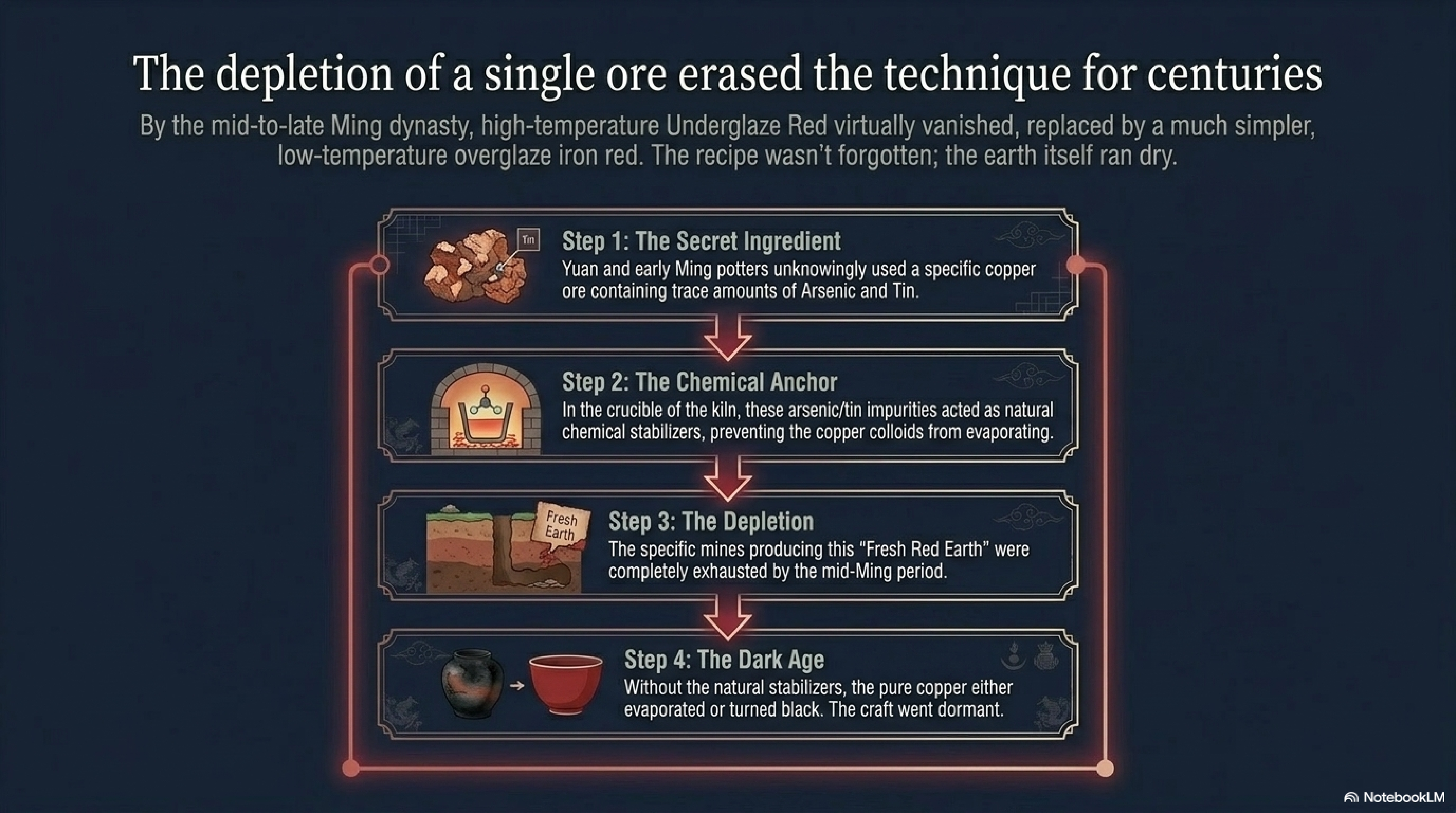
Technical interruption. The specific raw material (鲜红土) supplying the copper ore is exhausted. Underglaze red production effectively ceases. The court substitutes low-temperature overglaze alum red (矾红) — a fundamentally different, inferior material that merely simulates the colour.
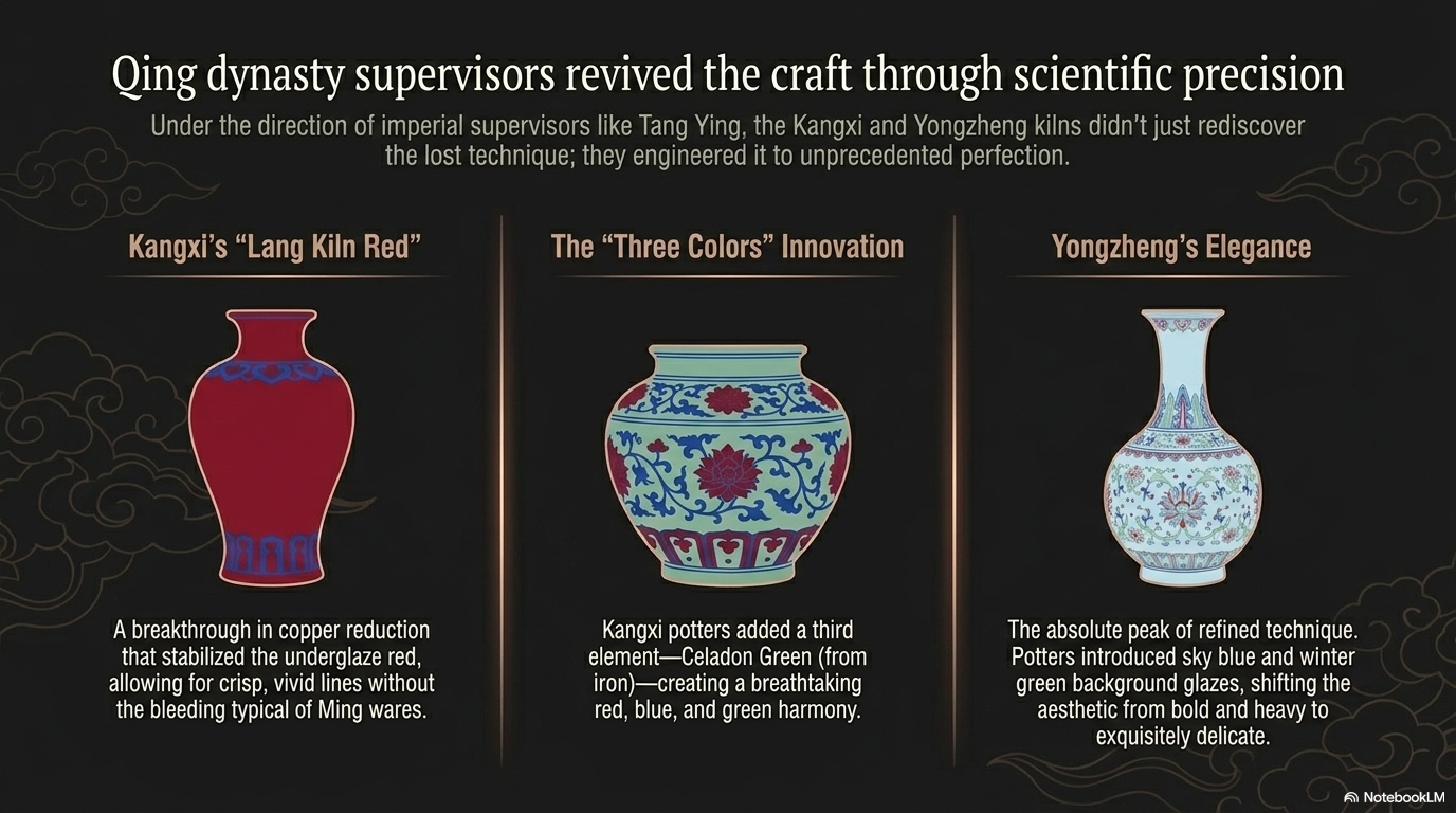
Revival and mastery. Kangxi successfully resurrects underglaze red. Yongzheng achieves the historical peak: colour bright and evenly distributed, "red flowers and blue leaves" (青花釉里红) at maximum chromatic harmony, 釉里三色 (three-colour underglaze — blue, red, and bean green) introduced. The Qing achievement is more consistent than the Ming peak; if less romantic, it is technically superior.
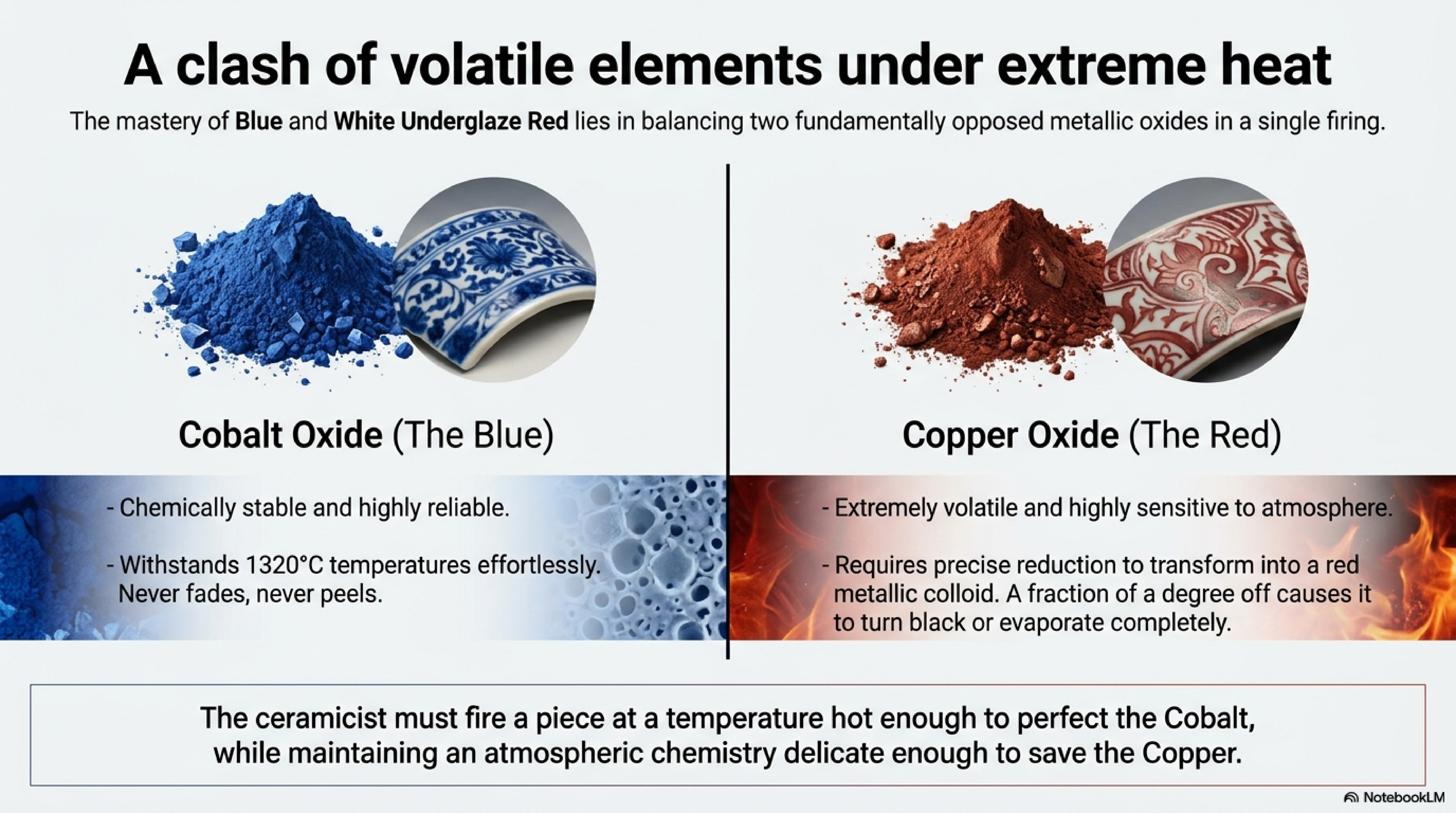
Underglaze red is a high-temperature underglaze colour: copper oxide is applied directly to the unfired clay body, a transparent glaze is applied over it, and the piece is fired in a single high-temperature reduction firing between 1250°C and 1350°C. The category it belongs to — alongside blue and white — is defined by this single-firing, high-temperature underglaze application. Everything else about the two traditions is different.
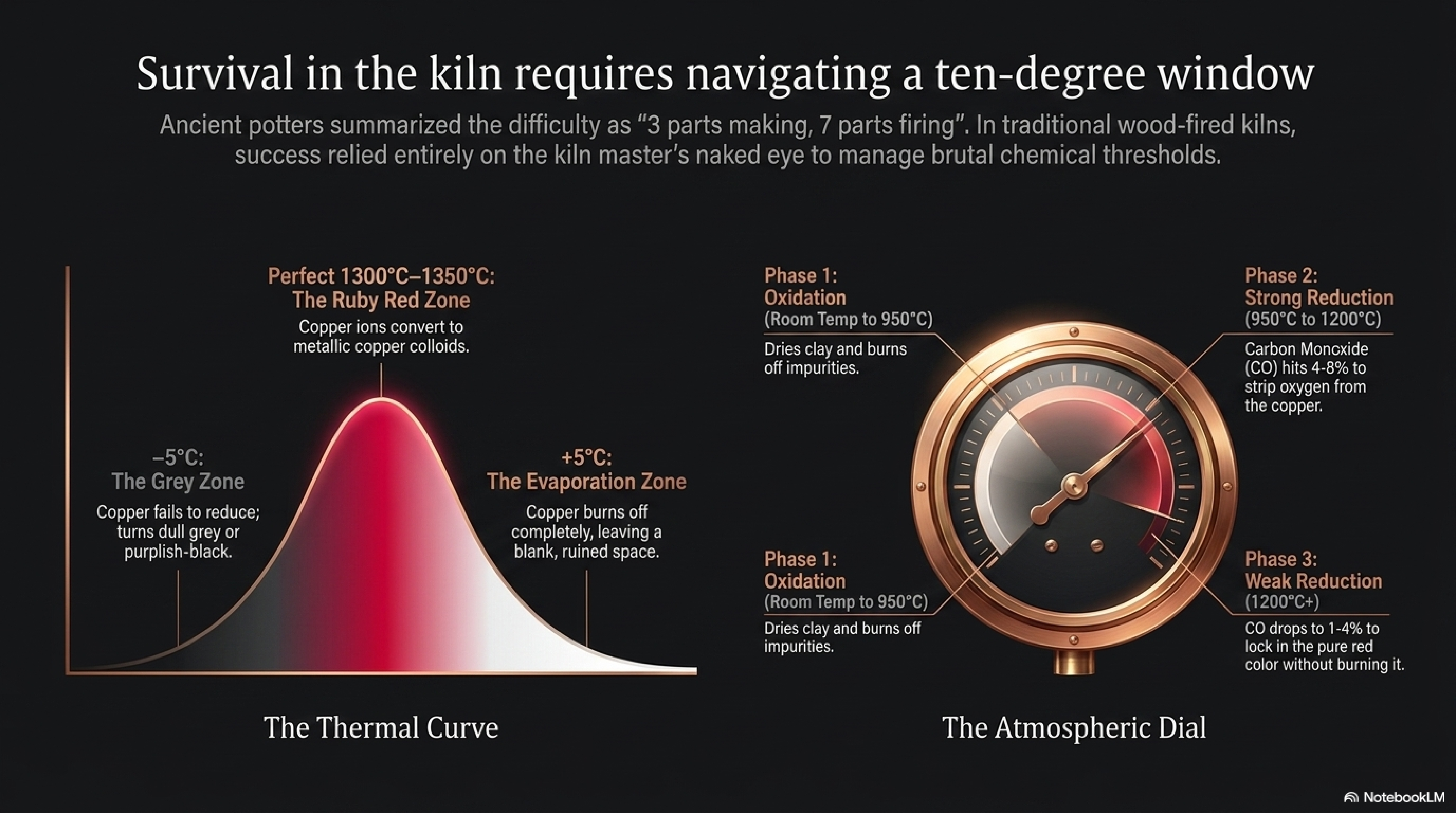
The copper chemistry. Copper oxide (CuO) in an oxidising kiln atmosphere (oxygen present) produces green or brown — the colour of celadon-adjacent glazes. In a reduction atmosphere (oxygen depleted, CO present), Cu²⁺ is reduced to Cu⁺ and, ultimately, to metallic copper nano-particles — which scatter red light and produce the ruby tone. But if the temperature exceeds the ideal zone, copper volatilises as CuO vapour and migrates away from the painted surface, leaving the painted area blank — known as "flying red" (飞红). The more common failure is the inverse: insufficient temperature or inadequate reduction produces grey, dark grey-purple, or black tones, as the copper fails to fully convert. Both failure modes flank the narrow ideal zone on either side.
The fundamental difficulty of underglaze red is the narrowness of its ideal firing zone. The copper must be hot enough to fully reduce (below this threshold: grey or black), but not so hot that it volatilises (above this threshold: nothing at all). This window is approximately 10°C wide — a tolerance that pre-modern kilns, fired with wood and managed by reading flame colour and smoke, could not reliably maintain across an entire firing load.
The temperature envelope. Below ideal zone (insufficient reduction): copper fails to fully convert, producing murky grey, dark grey-purple, or blackish tones — the characteristic failure mode of Yuan and Ming Hongwu underglaze red where kiln temperature was uneven. Ideal zone (~10°C range): full copper reduction to Cu⁺ nano-particles; clear, bright, saturated ruby red. Above ideal zone: copper volatilisation; the painted design vanishes, leaving a ghost of grey-white where the decoration should be. Modern electric kilns can hold ±2°C; traditional wood kilns varied by 50°C or more across a single firing.
Large vessels (Hongwu jars, Ming vases) present an additional challenge: thermal gradients. In a large pot firing in a wood kiln, the upper and lower halves of the same piece may differ by 30–50°C. This explains why Hongwu underglaze red frequently shows pure red at the shoulder and grey or absent colour at the base — same piece, different temperature zones, different copper conversion results.
Authentic Xuande underglaze red has a distinctive micro-texture on the red-painted areas: a slight convex surface with fine undulation, known as 橘皮纹 (orange-peel texture). This is caused by the slight expansion of copper-bearing areas during firing. It is a diagnostic marker of genuine Xuande production — later reproductions that achieve the right colour often lack this surface texture.
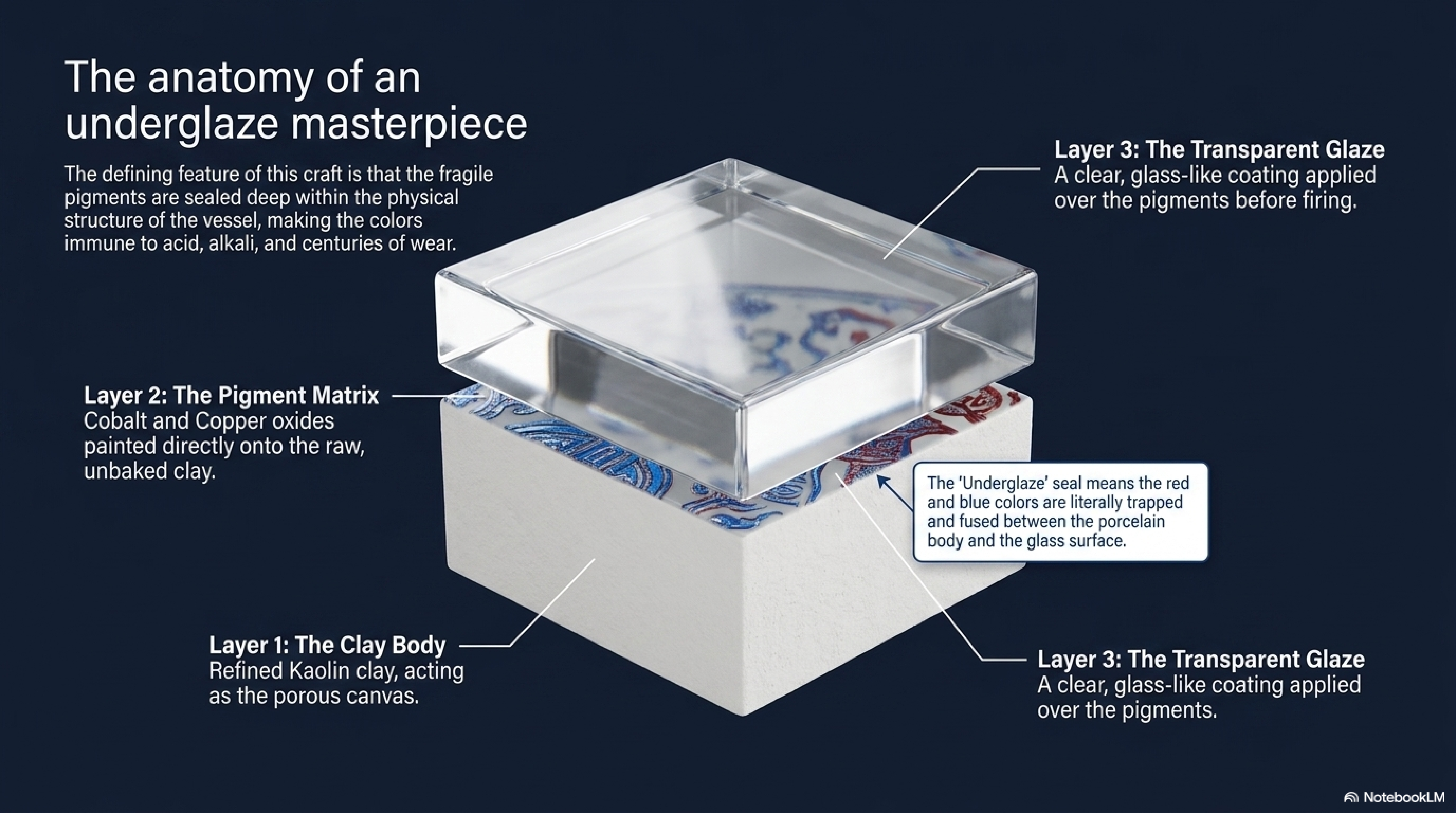
The anatomy of underglaze painting — three layers, one firing. Layer 1: The clay body — refined kaolin, acting as the porous canvas. The raw, unfired clay must be absorbent enough to accept the water-based pigment. Layer 2: The pigment matrix — copper oxide (for red) and cobalt oxide (for blue) painted directly onto the raw clay. The defining feature: the pigments are sealed deep within the physical structure of the vessel, making the colours immune to acid, alkali, and centuries of wear. Layer 3: The transparent glaze — a clear glass-like coating applied over the pigments before firing, locking everything in place. In the kiln, all three layers fuse simultaneously in a single high-temperature firing. The 'underglaze' seal means the red and blue colours are literally trapped and fused between the porcelain body and the glass surface.
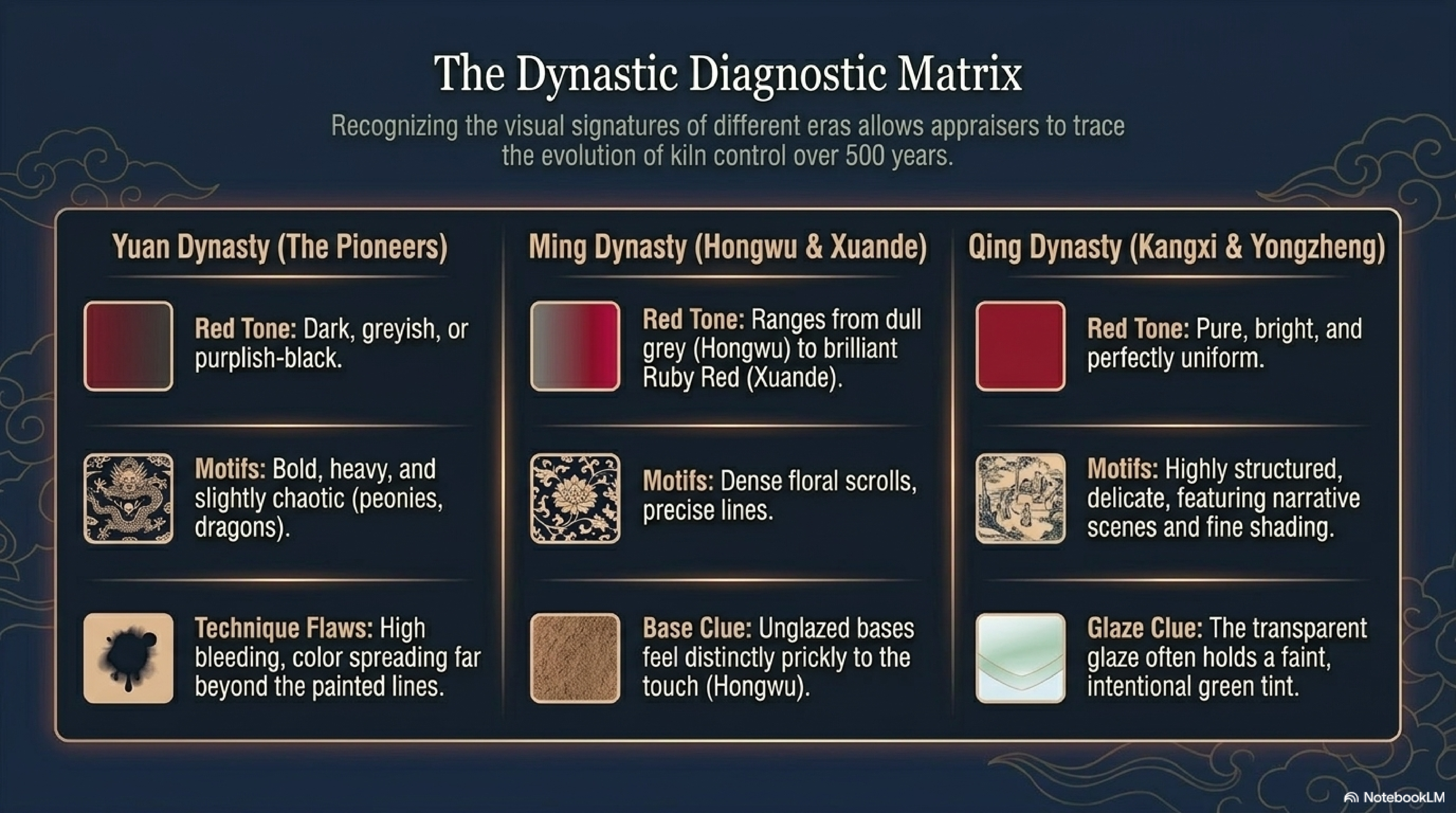
Each major production era of underglaze red has a characteristic colour tone, resulting directly from kiln technology, raw materials, and firing practice of its period. Reading these colour signatures is the first step in dating an unattributed piece.
The Dynastic Diagnostic Matrix. Recognising the visual signatures of different eras allows appraisers to trace 500 years of kiln control. Yuan: dark, greyish, or purplish-black red tone; bold heavy motifs (peonies, dragons); colour spreading far beyond painted lines — the hallmark of early experimental firing. Ming Hongwu: dull grey to grey-red; dense floral scrolls; unglazed foot bases feel distinctly prickly to the touch. Ming Xuande: brilliant Ruby Red (宝石红); same dense motifs at finer scale; foot gritty but not sandy. Qing Kangxi–Yongzheng: pure, bright, perfectly uniform red; highly structured delicate motifs with narrative scenes and fine shading; transparent glaze carries a faint intentional green tint.
Ground: qingbai or egg-white. Colour: dark red, grey-red, or near-absent — reflecting kiln temperature instability. Simple motifs. Surviving examples are extremely rare and command exceptional prices.
Large vessel scale. Ground: warm white, thick glaze. Colour: pale grey-red or shallow red at best, with frequent loss of colour at base due to thermal gradient in large forms. Unglazed sandy foot (糙底) on most pieces except specific forms.
Ground: pure cold white. Colour: deep ruby (宝石红) with orange-peel surface texture. The technical summit of Ming underglaze red — never surpassed in the Ming period. Also produced 青花釉里红 combining both colours. Reign mark: six-character regular script.
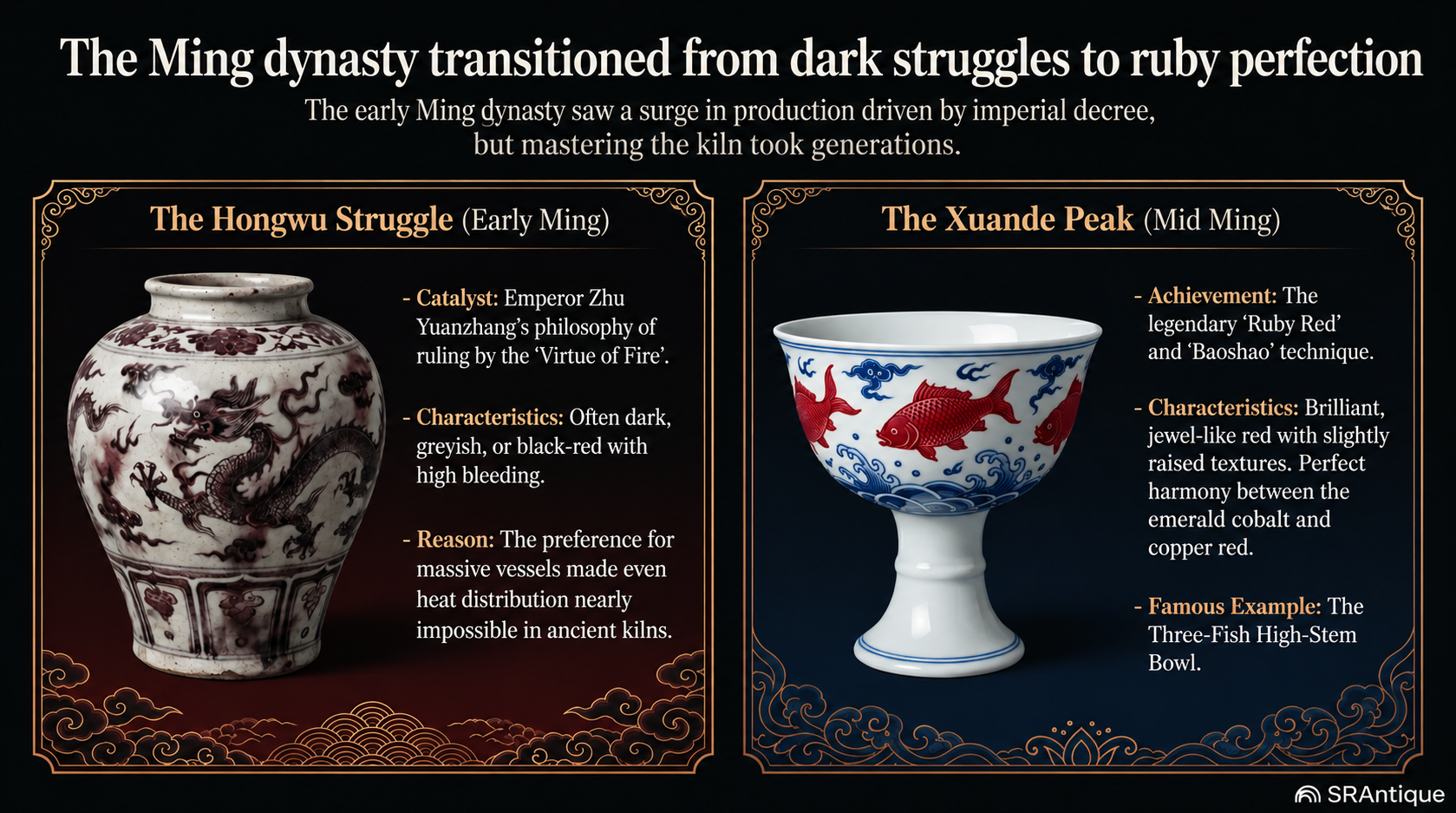
The Ming zenith: two very different reigns, two very different results. The Hongwu Struggle: Emperor Zhu Yuanzhang's philosophy of ruling by 'Virtue of Fire' drove large-scale underglaze red production — but the kiln technology of the period produced dark, greyish, or black-red tones with heavy colour bleeding. Massive vessel scale made even heat distribution nearly impossible in ancient kilns. The Xuande Peak: a complete reversal. The legendary 宝石红 (Ruby Red) — brilliant, jewel-like red with slightly raised orange-peel texture. The Three-Fish High-Stem Bowl stands as the iconic example: perfect harmony between emerald cobalt and copper red, a technical achievement never surpassed within the Ming period.
The Qing revival: scientific precision replaces craft intuition. Under imperial supervisors like Tang Ying, the Kangxi and Yongzheng kilns did not merely rediscover the lost technique — they engineered it to unprecedented perfection. Kangxi's 'Lang Kiln Red': a breakthrough in copper reduction that stabilised underglaze red, allowing crisp vivid lines without the bleeding typical of Ming wares. The Three-Colour Innovation (釉里三色): Kangxi potters added a third element — celadon green from iron — creating a breathtaking red, blue, and green harmony in a single underglaze firing, never achieved before. Yongzheng's Elegance: the absolute peak of refined technique. Potters shifted the aesthetic from bold-and-heavy to exquisitely delicate, introducing sky blue and winter green background glazes for the definitive Qing achievement.
Underglaze red is a prime forgery target — its rarity and high auction prices make it commercially attractive, and the visual appearance (a red-painted white porcelain) is superficially achievable with modern materials. Authentication focuses on four physical markers that are difficult to replicate simultaneously.
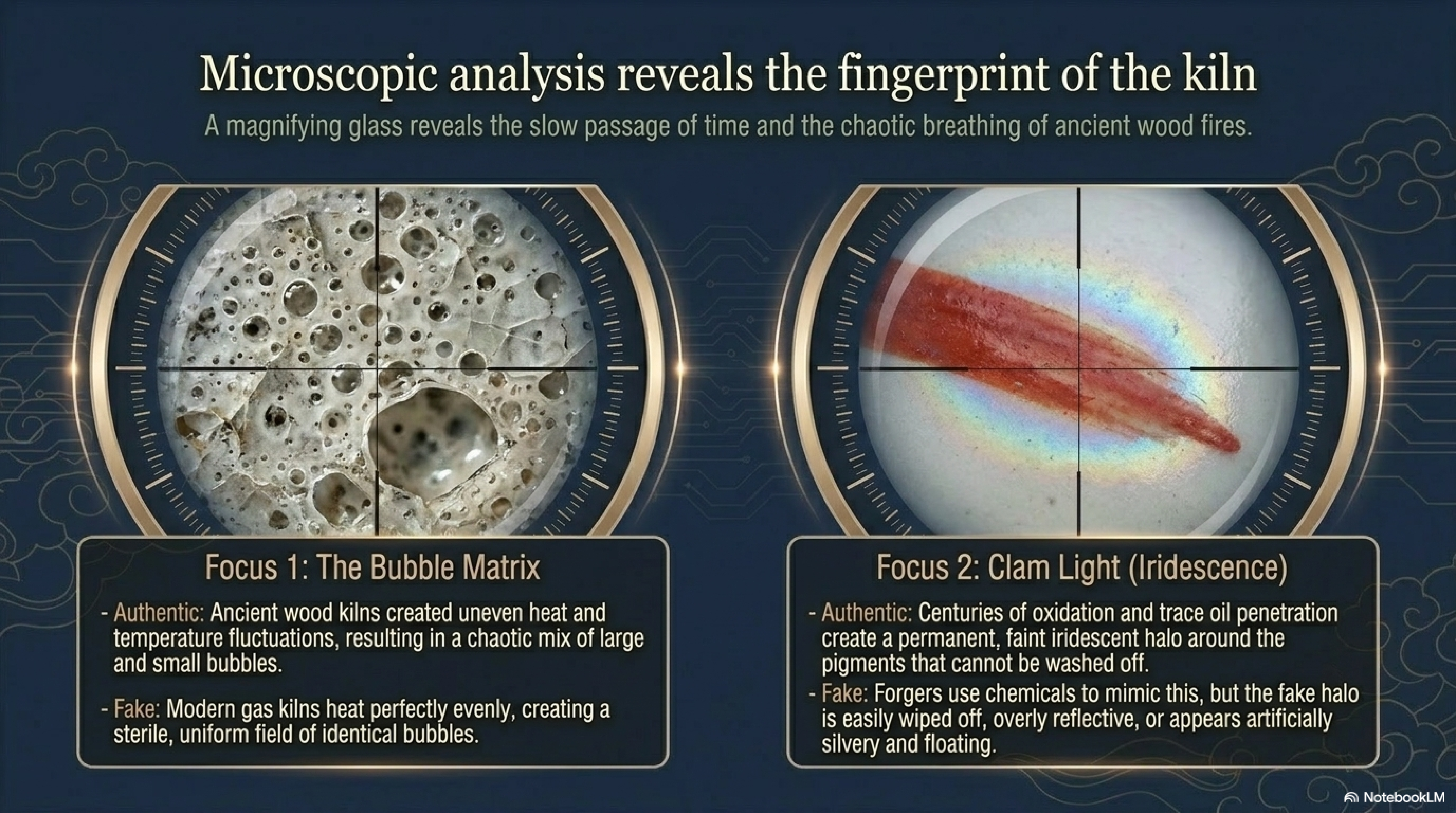
Microscopic authentication: the fingerprint of the kiln. A magnifying glass reveals the slow passage of time and the chaotic breathing of ancient wood fires. Focus 1 — The Bubble Matrix: Authentic pieces fired in ancient wood kilns show a chaotic mix of large and small bubbles, produced by uneven heat and temperature fluctuations. Modern gas kilns heat perfectly evenly, creating a sterile, uniform field of identical bubbles — immediately diagnostic at 30× magnification. Focus 2 — Clam Light (蛤蜊光, Iridescence): Centuries of oxidation and trace oil penetration create a permanent, faint iridescent halo around the pigments that cannot be washed off. Forgers use chemicals to mimic this effect, but the fake halo is easily wiped off, overly reflective, or appears artificially silvery. These two microscopic markers cannot be simultaneously faked by any current reproduction method.
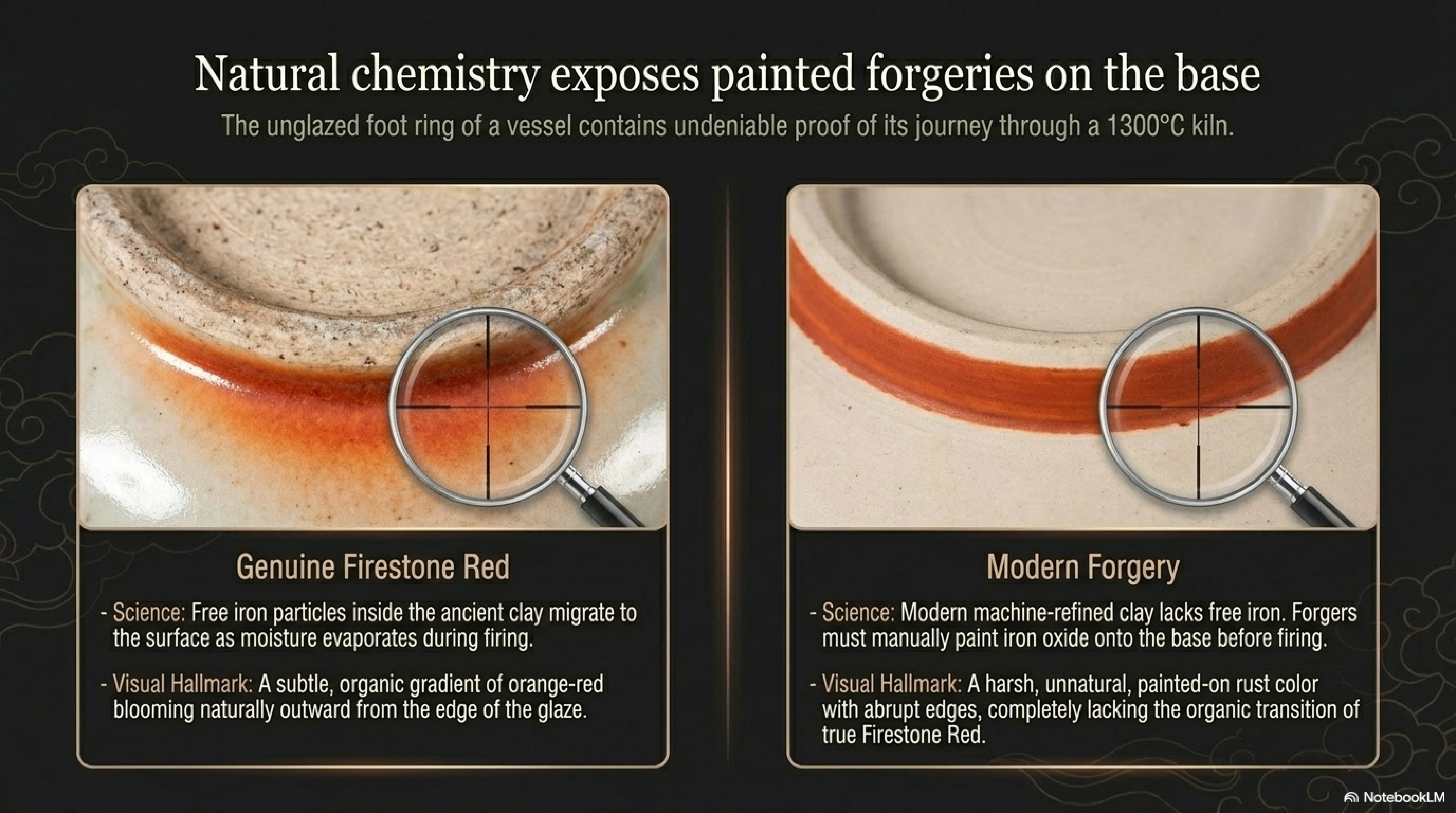
Firestone red: the base as a lie detector. The unglazed foot ring of a vessel contains undeniable proof of its journey through a 1300°C kiln. Genuine firestone red (火石红): free iron particles inside the ancient clay migrate to the surface as moisture evaporates during firing. The result is a subtle, organic gradient of orange-red blooming naturally outward from the edge of the glaze — irregular, warm, and continuously fading inward. Modern forgery: machine-refined clay lacks free iron. Forgers must manually paint iron oxide onto the base before firing. The result betrays itself: a harsh, unnatural, painted-on rust colour with abrupt edges, completely lacking the organic gradient of true firestone red.
Underglaze red's most significant legacy is not the single-colour tradition itself, but what Kangxi and Yongzheng craftsmen created by combining it with other underglaze colours — achieving a chromatic range no single pigment could produce alone.
The ore that built the tradition — and its disappearance. Why did underglaze red virtually vanish from Ming Jingdezhen for two centuries? The answer is geological. Step 1 — The Secret Ingredient: Yuan and early Ming potters unknowingly used a specific copper ore containing trace amounts of arsenic and tin. Step 2 — The Chemical Anchor: in the crucible of the kiln, these arsenic/tin impurities acted as natural chemical stabilisers, preventing the copper from evaporating at high temperatures. The potters did not know why their formula worked. Step 3 — The Depletion: the specific mines producing this '鲜红土' (Fresh Red Earth) were completely exhausted by the mid-Ming period. Step 4 — The Dark Age: without the natural stabilisers, pure copper oxide either evaporated or turned black. The craft went dormant — not forgotten, but materially impossible to revive until Qing kilnmasters found alternative stabilisation methods.
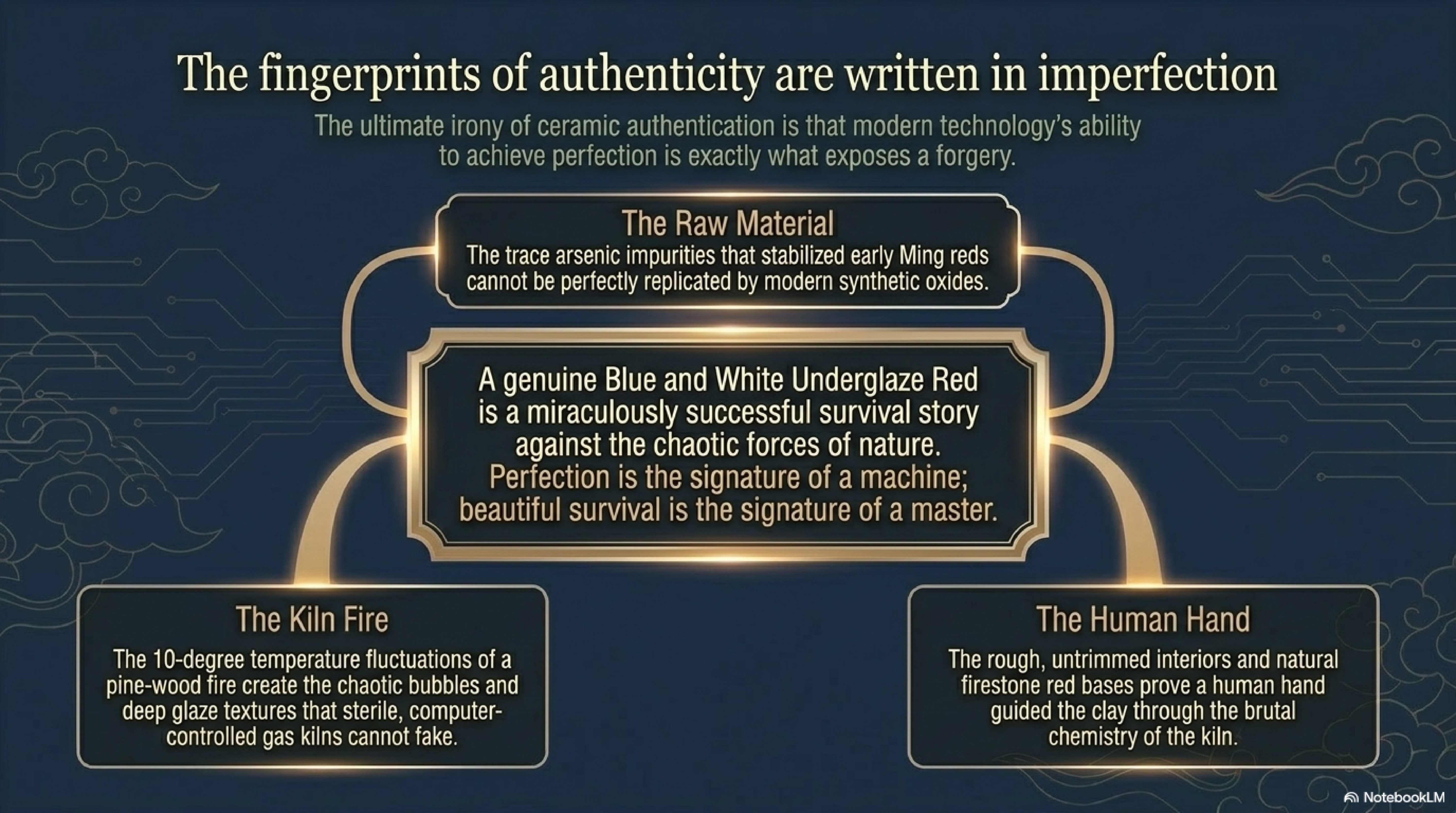
The ultimate paradox of authentication: perfection is the mark of a fake. Modern technology can achieve what centuries of kiln masters could not — perfectly uniform colour, perfectly smooth glaze, perfectly symmetrical form. And that perfection is precisely what exposes a reproduction. Three fingerprints that cannot be faked simultaneously: The Raw Material — trace arsenic impurities that stabilised early Ming reds cannot be perfectly replicated by modern synthetic copper oxides; the colour signature is subtly different under spectroscopic analysis. The Kiln Fire — the 10-degree temperature fluctuations of a pine-wood fire create the chaotic bubble matrix and deep glaze textures that sterile, computer-controlled gas kilns cannot reproduce. The Human Hand — rough untrimmed interiors and natural firestone red bases prove a human hand guided the clay through the brutal chemistry of the kiln. A genuine piece is a miraculously successful survival story against the chaotic forces of nature; perfection is the signature of a machine.
"The kiln makes the colour. The painter makes the form. But between them, there is a ten-degree gap that neither controls."
— On the fundamental character of underglaze red: unlike every other ceramic colour in the Chinese tradition, the final quality of underglaze red is determined not by the painter's skill or the glaze chemist's formula, but by the ten-degree zone of atmospheric and thermal conditions that no one, in any dynasty, has ever fully mastered.