Jingdezhen · Six Great Ceramics · No. 5

Wucai Porcelain 五彩瓷

硬彩烈色,热烈奔放 · Five Colours in Bold Contention

Vivid, bold, unapologetically rich. Wucai — "five colours" — is the most visually assertive of Jingdezhen's great traditions. From Ming Jiajing excess to Kangxi's 釉上蓝彩 invention: the hard colour that never whispers.

嘉靖/万历 First Peak
康熙 Technical Summit
硬彩 Alternative Name
釉上蓝彩 Kangxi Innovation

Bold, Vivid, Unapologetic: The Hard Colour Tradition

Wucai (五彩) — literally "five colours," also known as 硬彩 ("hard colours") — is the fifth of Jingdezhen's Four Great Ceramics and the most visually assertive of them all. Its name does not prescribe exactly five colours; it denotes a polychrome aesthetic grounded in bold, saturated colour fields of red, yellow, green, and blue — applied flat, without tonal gradation, in the direct, uncompromising manner that distinguishes it from the soft modulation of Famille Rose (粉彩) and the precisely outlined delicacy of Doucai (斗彩).

Wucai reached its first great peak under the Jiajing (1522–1566) and Wanli (1573–1620) emperors — the tradition Europeans would call "Old Japan" or "Imari" after its Japanese reinterpretation — and its technical summit under Kangxi (1662–1722), when the invention of overglaze blue enamel (釉上蓝彩) freed the tradition from its dependence on underglaze cobalt and completed the polychrome palette. To understand Wucai is to understand Chinese ceramics at its most direct and most vivid.

青花
Blue & White
Cobalt on white. Yuan to Qing. The most globally traded Chinese ceramic.
釉里红
Underglaze Red
Copper on white. "A thousand kilns for one treasure." The rarest high-fire colour.
斗彩
Doucai
Underglaze blue outlines, overglaze enamel fills. Ming Chenghua — the rarest formula.
粉彩
Famille Rose
Opaque pink enamels from Europe. Qing Yongzheng / Qianlong. The auction market's summit.
五彩
Wucai
Five-colour overglaze. Ming Jiajing / Wanli. Bold, vivid, folk-inflected energy. This guide.
颜色釉
Monochrome
Fire, metal oxide, restraint. From Ming sacrificial red to Qing peachbloom. One colour, one fire.

"万历五彩,满目锦绣。"

Wanli Wucai's defining quality is fullness — the composition covers the vessel surface without restraint, colour meets colour without hesitation, and the result is a visual density that later connoisseurs alternately admired and found exhausting. The Wanli court's appetite for this kind of saturated decoration drove the largest single expansion of the Jingdezhen export trade in the Ming dynasty.

From Song Experiment to Kangxi Hard Colour

Wucai's development is longer and more complex than any other Jingdezhen tradition. Its roots lie in the Song dynasty's early experiments with overglaze colour on stoneware; its canonical form emerges in the Xuande court; its dominant period is the Jiajing-Wanli era; and its technical culmination arrives under Kangxi with an innovation that fundamentally altered the colour palette available to Chinese ceramics.

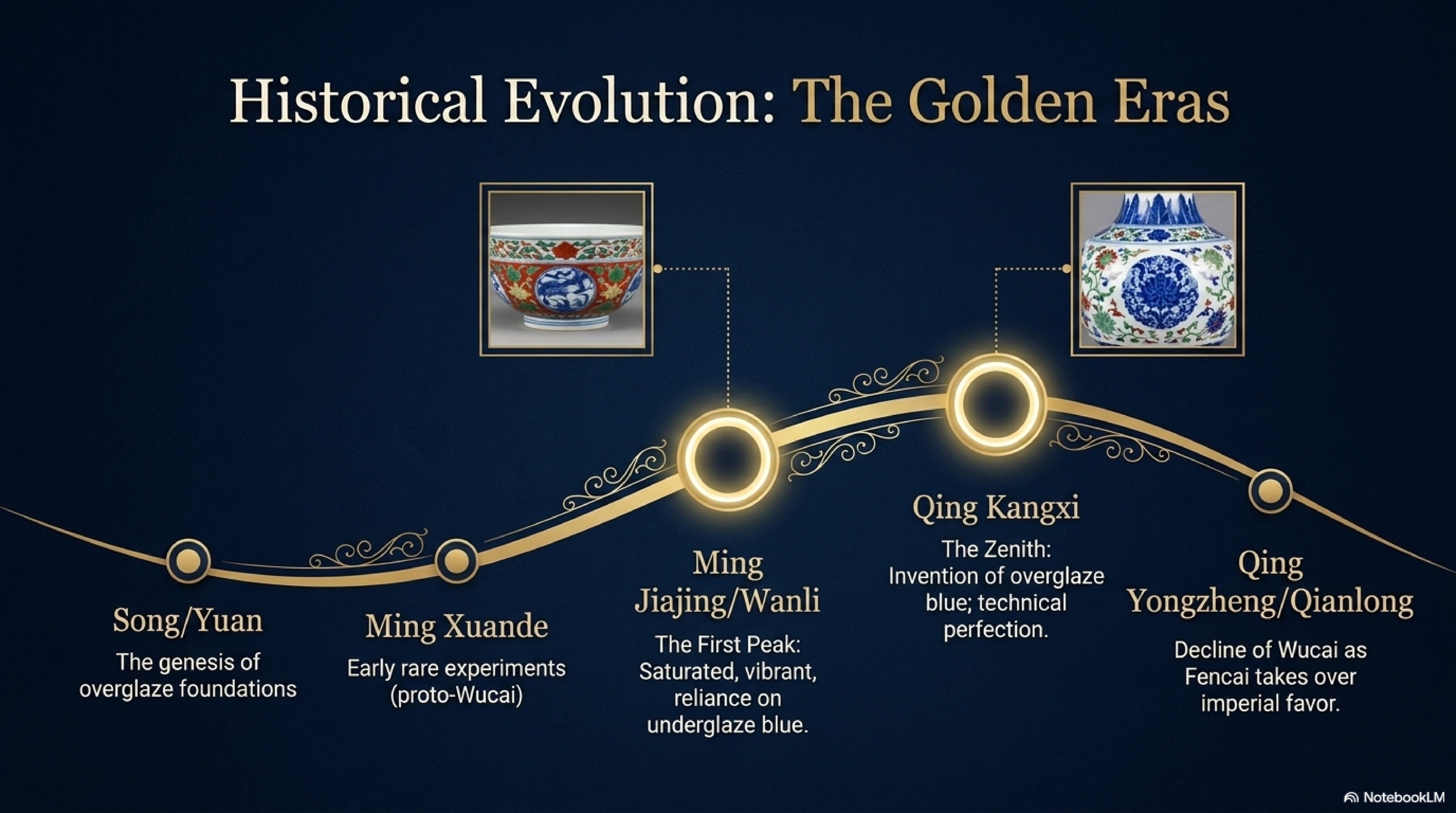
Historical Evolution — The Golden Eras of Wucai: timeline from Song/Yuan overglaze foundations through Ming Xuande proto-Wucai, Ming Jiajing/Wanli first peak, Qing Kangxi zenith with overglaze blue invention, to Qing Yongzheng/Qianlong decline as Fencai takes imperial favour
The developmental arc of Wucai. Song/Yuan: the genesis of overglaze colour foundations — the technical logic of post-fire enamel decoration is established. Ming Xuande: early rare experiments (proto-Wucai). Ming Jiajing/Wanli: The First Peak — saturated, vibrant decoration in bold red-green contrast, still relying on underglaze cobalt for blue. Qing Kangxi: The Zenith — invention of overglaze blue (釉上蓝彩) and technical perfection of 硬彩. Qing Yongzheng/Qianlong: decline as Famille Rose (粉彩) takes over imperial favour.
Song–Yuan
(960–1368)
Foundational experiments. Early Chinese potters develop overglaze colour (釉上加彩) on stoneware and porcelain bodies. The technical principle — applying colour to a fired, glazed surface and re-firing at low temperature — is established. Not yet Wucai as a named tradition, but the technical logic is in place.
Ming Xuande
(1426–1435)
The prototype. The 青花五彩莲池鸳鸯纹碗, discovered in the Tibet Sakya Monastery, establishes the mature 青花五彩 format: underglaze cobalt as one colour field among several, combined with overglaze red, yellow, and green enamels. This is the ancestor of both Wucai and Doucai — the distinction between them would be systematised by later connoisseurship.
Ming Jiajing
(1522–1566)
First peak. Wucai reaches its first high-water mark. The Jiajing palette is dominated by 枣皮红 (date-skin red, a deep iron-red) and 孔雀绿 (peacock green). Decorative schemes are bold and mythologically charged — Daoist themes, auspicious creatures, the Eight Trigrams. Brushwork is confident and slightly coarse; the visual effect is forceful.
Ming Wanli
(1573–1620)
"大明彩" peak. Wanli Wucai — sometimes called 大明彩 (Great Ming Colour) — pursues maximum decorative density. Compositions cover the entire vessel surface; the colour palette leans toward 红绿对比 (red-green contrast); individual motifs are rendered in dense, full-saturation enamels. Wanli vessels are frequently large and heavy; the approach is cumulative and uncompromising.
Qing Kangxi
(1662–1722)
Technical summit — 硬彩. Two innovations define Kangxi Wucai. First: the invention of overglaze blue enamel (釉上蓝彩) — for the first time, cobalt blue could be applied above the glaze rather than beneath it, freeing the painter from the two-firing constraint for blue. Second: gold enamel (金彩) is systematically integrated into Wucai decoration. The Kangxi result — 硬彩 at its technical peak — is a palette of six or more distinct, assertive colours applied with precision and deliberation.
Post-Yongzheng
(after 1735)
Decline and continuation. As Famille Rose (粉彩) rises to court favour under Yongzheng and Qianlong, Wucai loses its position as the dominant Jingdezhen polychrome. Production continues at reduced scale; the most technically ambitious work shifts to 粉彩 and 斗彩-粉彩 combinations. Late Qing and Republican revivals occur, but the tradition's defining character is firmly fixed in the Ming-Kangxi period.
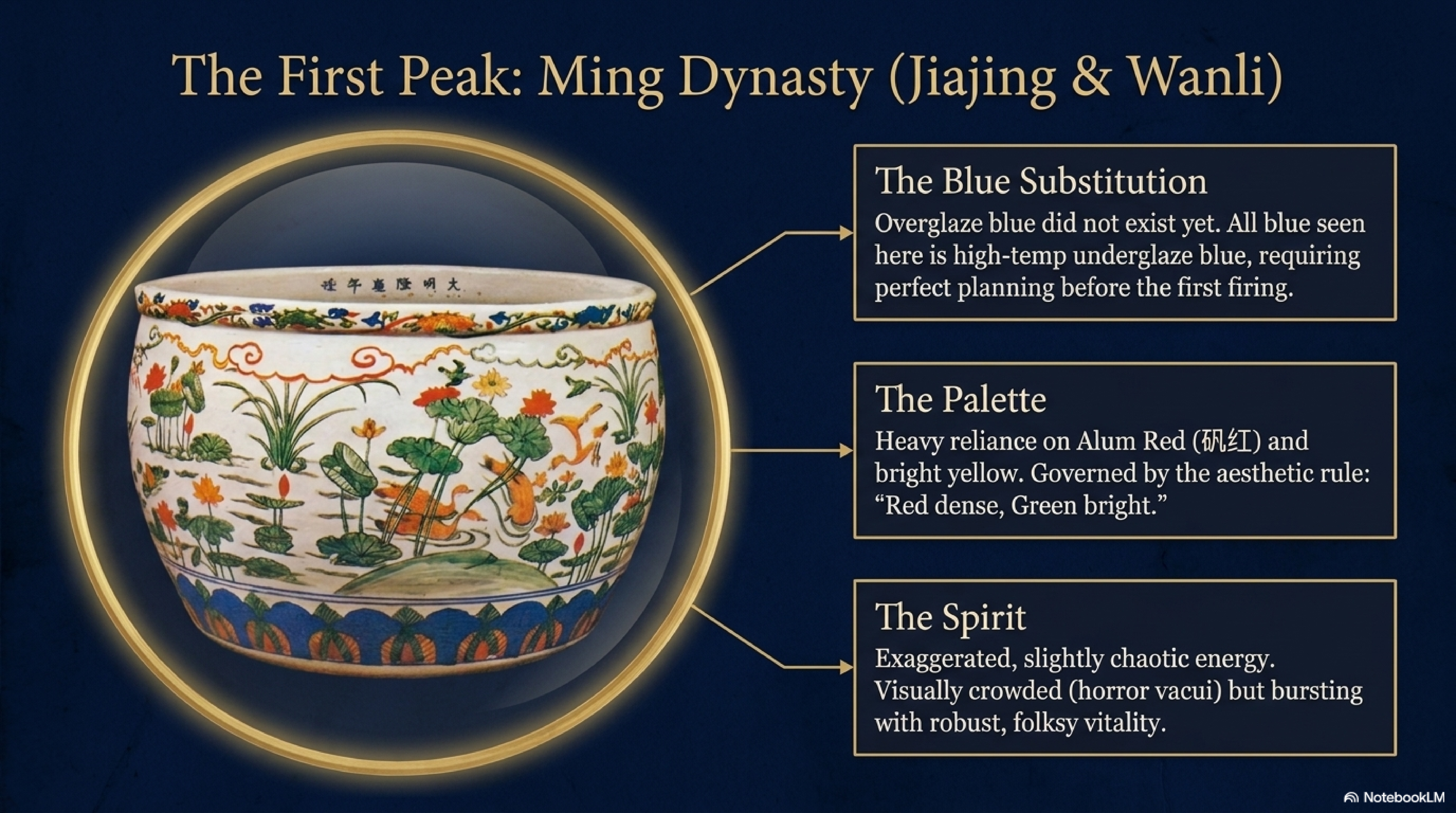
The First Peak: Ming Dynasty — large Jiajing/Wanli Wucai jar annotated with defining period characteristics: underglaze blue substitution (no overglaze blue yet), Alum Red palette (矾红) with bright yellow, and slightly chaotic horror vacui surface energy
Wanli Wucai — 大明彩 at its most characteristic. A large Jiajing/Wanli jar annotated with three defining features: The Blue Substitution — all blue is still underglaze cobalt, requiring perfect planning before the first firing, as overglaze blue had not yet been invented. The Palette — heavy reliance on Alum Red (矾红) and bright yellow, governed by the aesthetic rule "Red dense, Green bright." The Spirit — exaggerated, slightly chaotic energy; visually crowded (horror vacui) but bursting with robust, folksy vitality.
Flat Colour Fields, Direct Application: The Wucai Method

Wucai's technical logic is more straightforward than Doucai or Famille Rose — but straightforward does not mean simple. The discipline of flat-colour application at high quality, the coordination of underglaze cobalt with multiple overglaze colours, and the invention of overglaze blue by the Kangxi court each represent significant technical achievements.

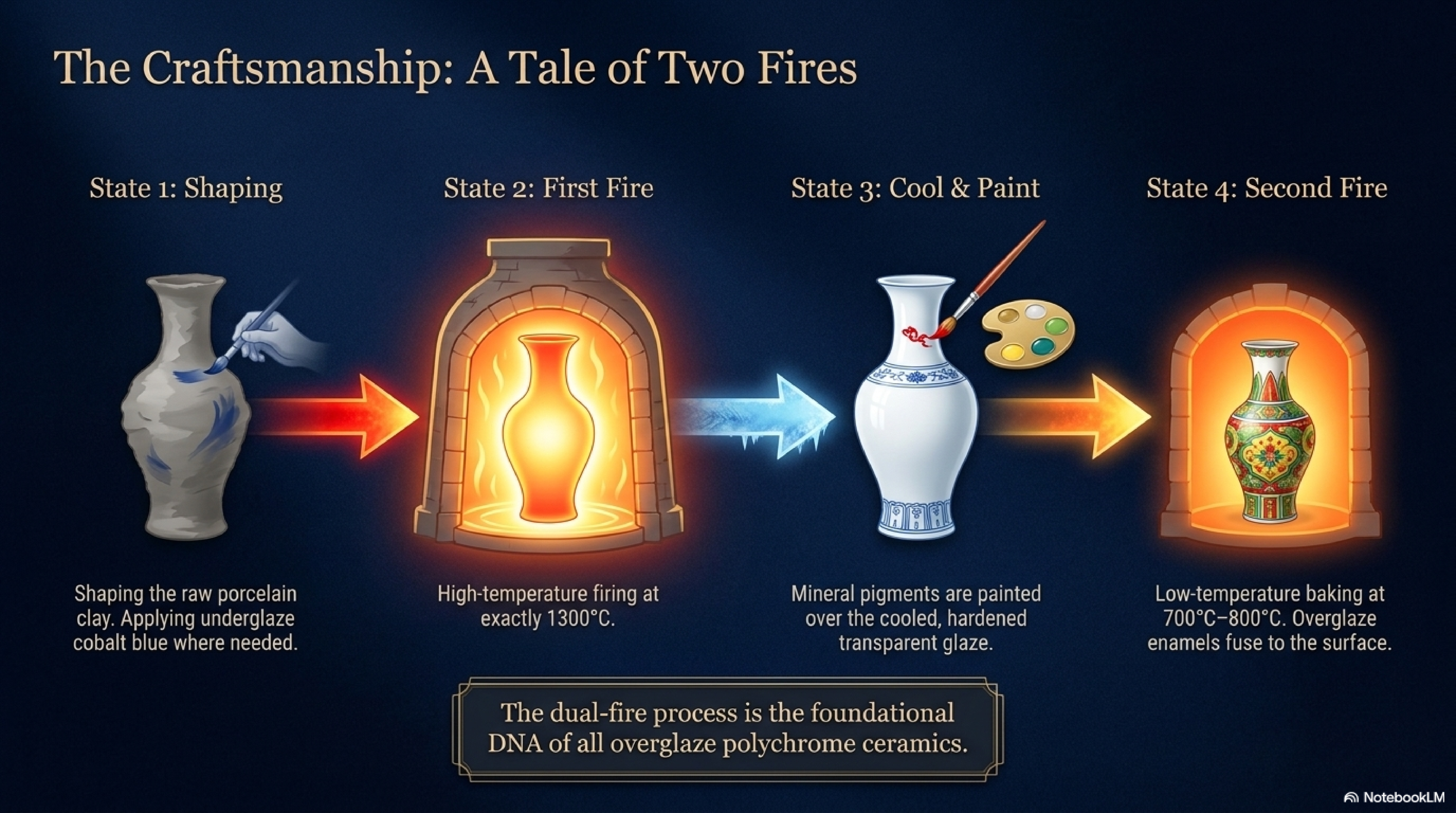
The Craftsmanship — A Tale of Two Fires: 4-stage diagram of Wucai production showing clay shaping with underglaze cobalt application, high-temperature first firing at 1300°C, cooling and painting mineral pigments over hardened glaze, and low-temperature second firing at 700–800°C where overglaze enamels fuse to the surface
The Wucai two-firing process. Stage 1 — Shaping: the raw porcelain clay is shaped; underglaze cobalt blue is applied where needed. Stage 2 — First Fire: high-temperature firing at exactly 1300°C fuses the body and seals the cobalt under transparent glaze. Stage 3 — Cool & Paint: mineral pigments are painted over the cooled, hardened transparent glaze as flat overglaze colour fields, applied without blending. Stage 4 — Second Fire: low-temperature baking at 700–800°C fuses the overglaze enamels to the surface, producing the hard, assertive 硬彩 character.

The Flat-Colour Aesthetic (平涂技法)

Where Famille Rose uses 洗染 (soft-brush blending) to achieve tonal gradation, Wucai uses 平涂 (píngtú, flat-wash application): each colour is applied uniformly within its designated zone, without deliberate variation in density or saturation. The visual energy of Wucai comes not from tonal modulation within a single colour area but from the juxtaposition of multiple saturated, unmodulated colour fields against each other. Red against green; yellow against blue; green against white. The colour relationships do all the visual work that shading does in Famille Rose.

The Kangxi Innovation: Overglaze Blue (釉上蓝彩)

The most significant technical development in Wucai's history is the Kangxi court's invention of overglaze blue enamel (釉上蓝彩). Before this, any blue in a polychrome composition had to be underglaze cobalt — applied before glazing, fired at 1300°C, irrevocably committed. This constrained the composition at the design stage and required careful coordination between the underglaze painter and the overglaze decorator. From the Kangxi period, blue could be applied above the glaze alongside all other colours in the second firing — freeing the painter from the two-stage commitment and allowing a fully integrated polychrome composition in a single decorating session.

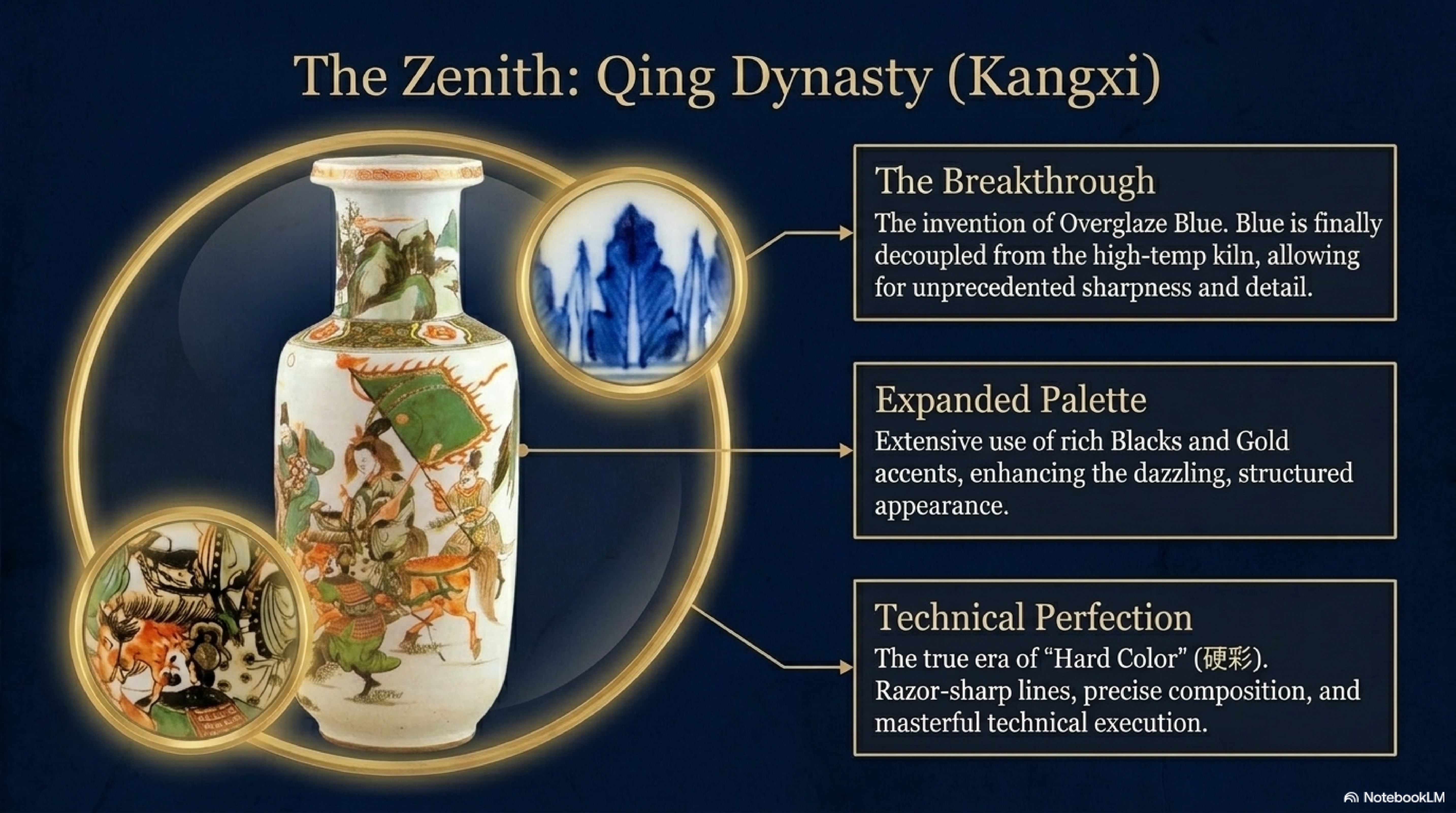
The Zenith: Qing Dynasty (Kangxi) — Kangxi Wucai rouleau vase annotated with three landmark achievements: The Breakthrough (overglaze blue 釉上蓝彩 decoupled from high-temp kiln), Expanded Palette (blacks and gold accents), Technical Perfection (razor-sharp lines, Hard Color 硬彩)
Kangxi 硬彩 — the technical zenith. A Kangxi Wucai rouleau vase annotated with the era's defining innovations. The Breakthrough: the invention of overglaze blue (釉上蓝彩) — for the first time blue could be applied above the glaze alongside all other colours in the second firing, freeing the decorator from the underglaze constraint. Expanded Palette: extensive use of rich blacks and gold accents enhancing the dazzling, structured appearance. Technical Perfection: razor-sharp lines, precise composition, and masterful technical execution — the true era of 硬彩 (Hard Color).

Reading the Period: Colour Tone and Decorative Density

Three criteria allow preliminary period attribution for Wucai: the characteristic palette of each period (specific red types, green qualities, blue source), the decorative density and coverage, and the figure type in narrative scenes. These are visual criteria that require familiarity with period examples — there are no technical substitutes for looking at authenticated originals.

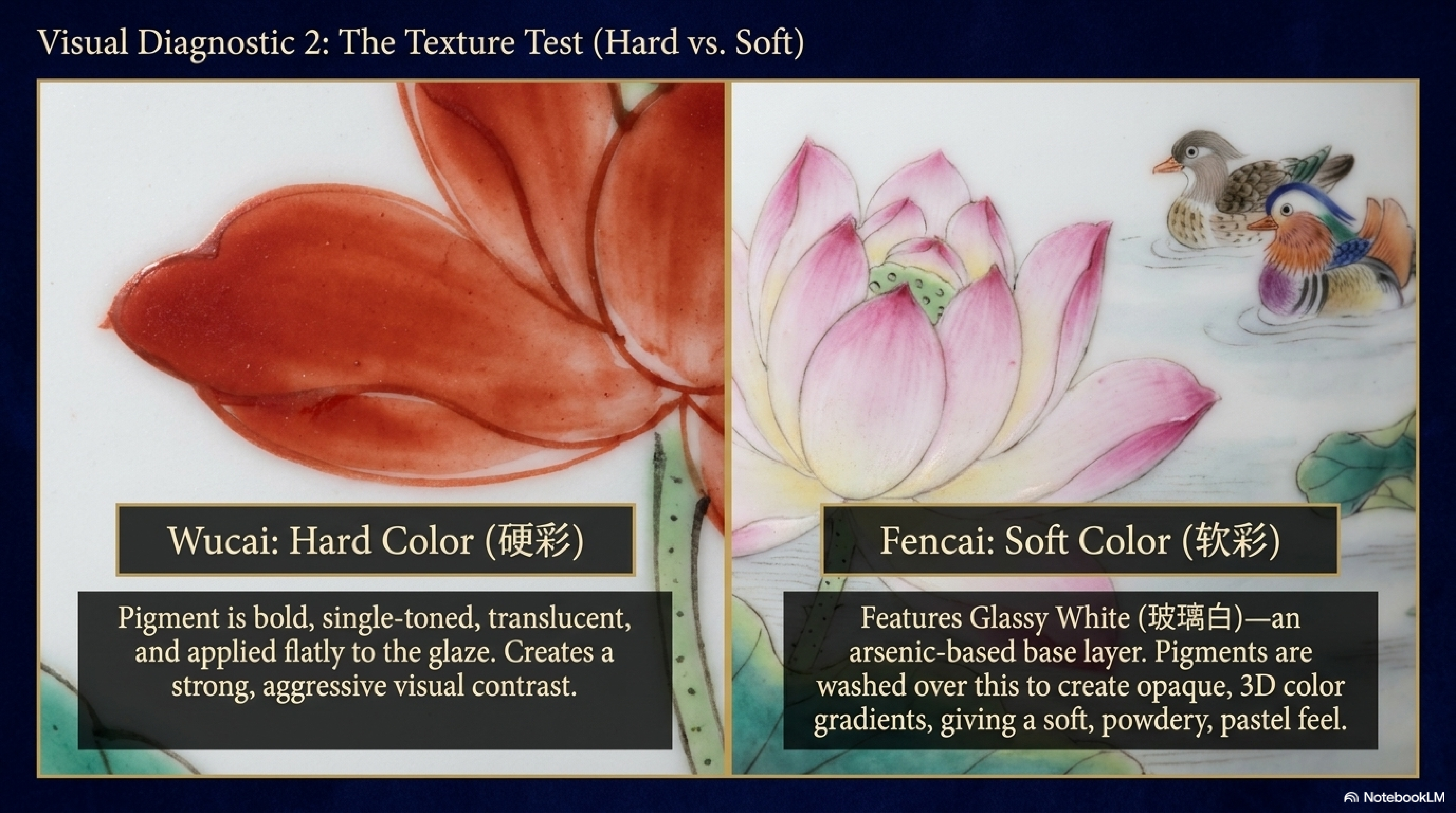
Visual Diagnostic — Hard Color vs Soft Color: Wucai lotus leaf (bold, single-toned, flat translucent red pigment creating strong aggressive visual contrast) contrasted with Fencai mandarin ducks (opaque 3D colour gradients washed over Glassy White base with soft powdery pastel depth)
Visual Diagnostic 2: The Texture Test. Wucai (left): 硬彩 — the pigment is bold, single-toned, translucent, and applied flatly to the glaze surface, creating strong, aggressive visual contrast. Fencai (right): 软彩 — features Glassy White (玻璃白), an arsenic-based base layer, over which pigments are washed to create opaque, 3D colour gradients with a soft, powdery pastel feel. The difference is immediately legible to the trained eye and is one of the primary tools for tradition identification and period attribution.
Jiajing Wucai · 嘉靖五彩 Ming Jiajing 1522–1566

First great Wucai peak. Palette dominated by 枣皮红 (date-skin iron-red, deep and warm) and 孔雀绿 (peacock green, vivid and slightly blue-green). Decorative themes: Daoist iconography, mythological creatures (dragons, phoenixes, 道教八卦). Brushwork confident but with slightly coarse line character — the decoration has energy and force rather than delicacy. Underglaze cobalt used as spatial structure.

Wanli Wucai · 万历五彩 Ming Wanli 1573–1620

大明彩 — maximum density and saturation. Red and green dominate in high-contrast opposition; compositions cover the full vessel surface without margin. Motifs are narrative and cumulative — figures, landscapes, animals, flowers all coexist without compositional hierarchy. Vessels tend to be large and heavy. The Wanli period produced Wucai pieces in the largest quantities of any Ming reign, and its visual language defined European perceptions of Chinese decorative ceramics.

Kangxi Wucai · 康熙五彩 Qing Kangxi 1662–1722

硬彩 summit. Defining markers: 釉上蓝彩 (overglaze blue enamel — its presence immediately places a piece in or after the Kangxi period) and 金彩 (gold enamel). Brushwork is precise and painterly; figure types show literati influence — slender scholars, elegant women with fine features. Decorative density is lower than Wanli; compositions have more white ground. Colour is brilliant and clear, without the warm heaviness of Jiajing iron-red.

Later Wucai · 后期五彩 Yongzheng–Late Qing

Post-Yongzheng Wucai declines in court status as Famille Rose (粉彩) dominates imperial production. Later Wucai pieces are often smaller and more carefully composed than Wanli examples; the palette is somewhat reduced; the decorative ambition is more restrained. Late Qing and Republican pieces occur but represent a diminished tradition. Exceptional Republican-period 硬彩 pieces exist but are exceptions.

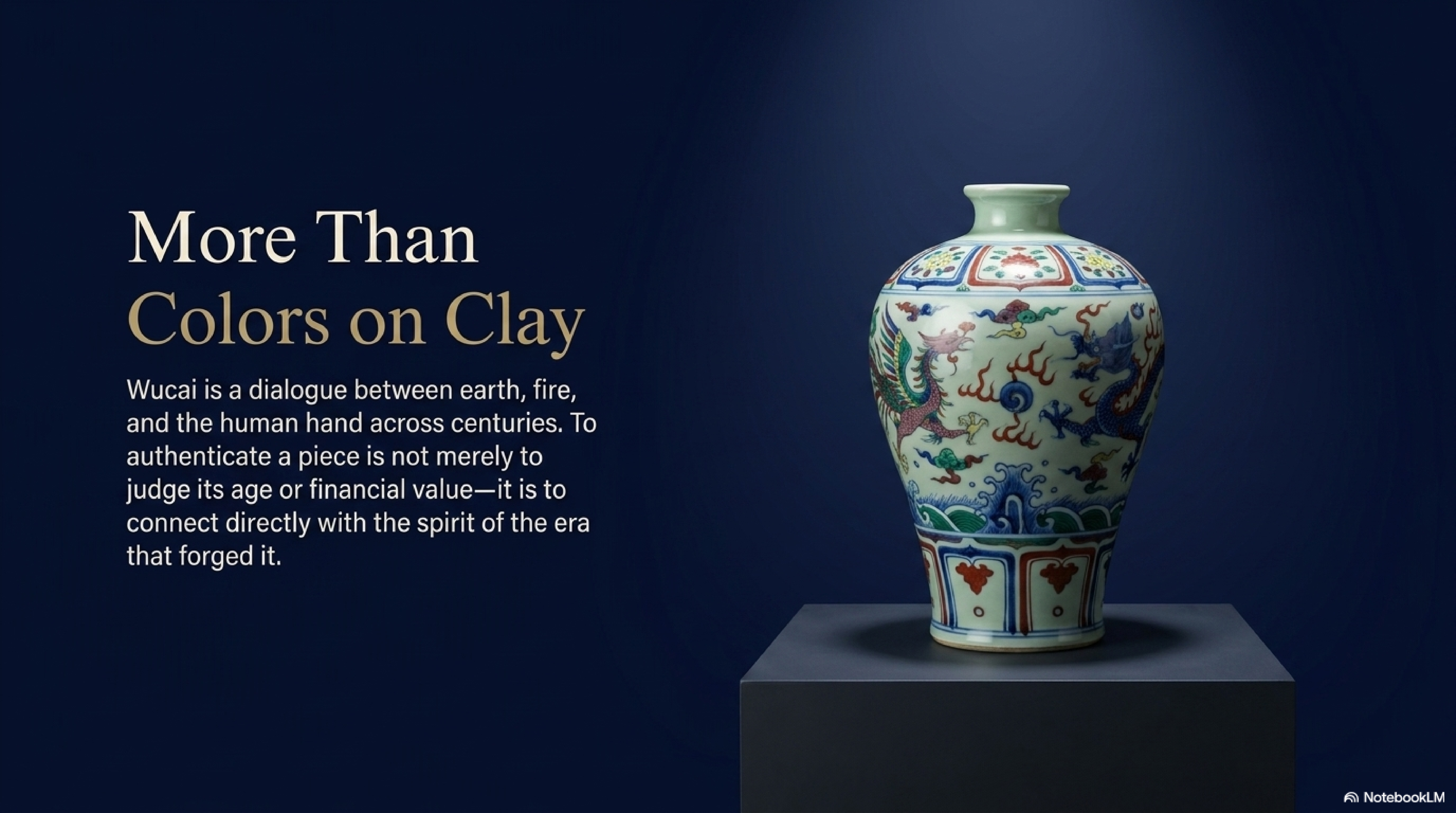
Wucai meiping (梅瓶) — masterwork vessel displaying bold underglaze blue dragons as colour field among overglaze red, green, and yellow enamels in full unmodulated saturation against a white ground
A Wucai meiping (梅瓶) at its finest: the characteristic logic of 五彩 in physical form. The underglaze blue dragon is a colour participant — one zone among several — not a structural outline. Red, green, and yellow overglaze enamels occupy adjacent zones in full, unmodulated saturation. To date this piece: identify whether the blue is underglaze cobalt (Ming peak) or overglaze enamel (Kangxi onwards); read the red quality for date-skin iron-red (Jiajing/Wanli) or refined enamel red (Kangxi); assess decorative density and figure type.

Old vs. New: Wucai Authentication Markers

Wucai authentication focuses on five physical markers: the quality and character of the clam-shell iridescence on aged enamel, the fire stone red at the foot rim, the brushwork vitality of the figural painting, the specific enamel colour tones for each period, and the structural evidence of the foot and body.

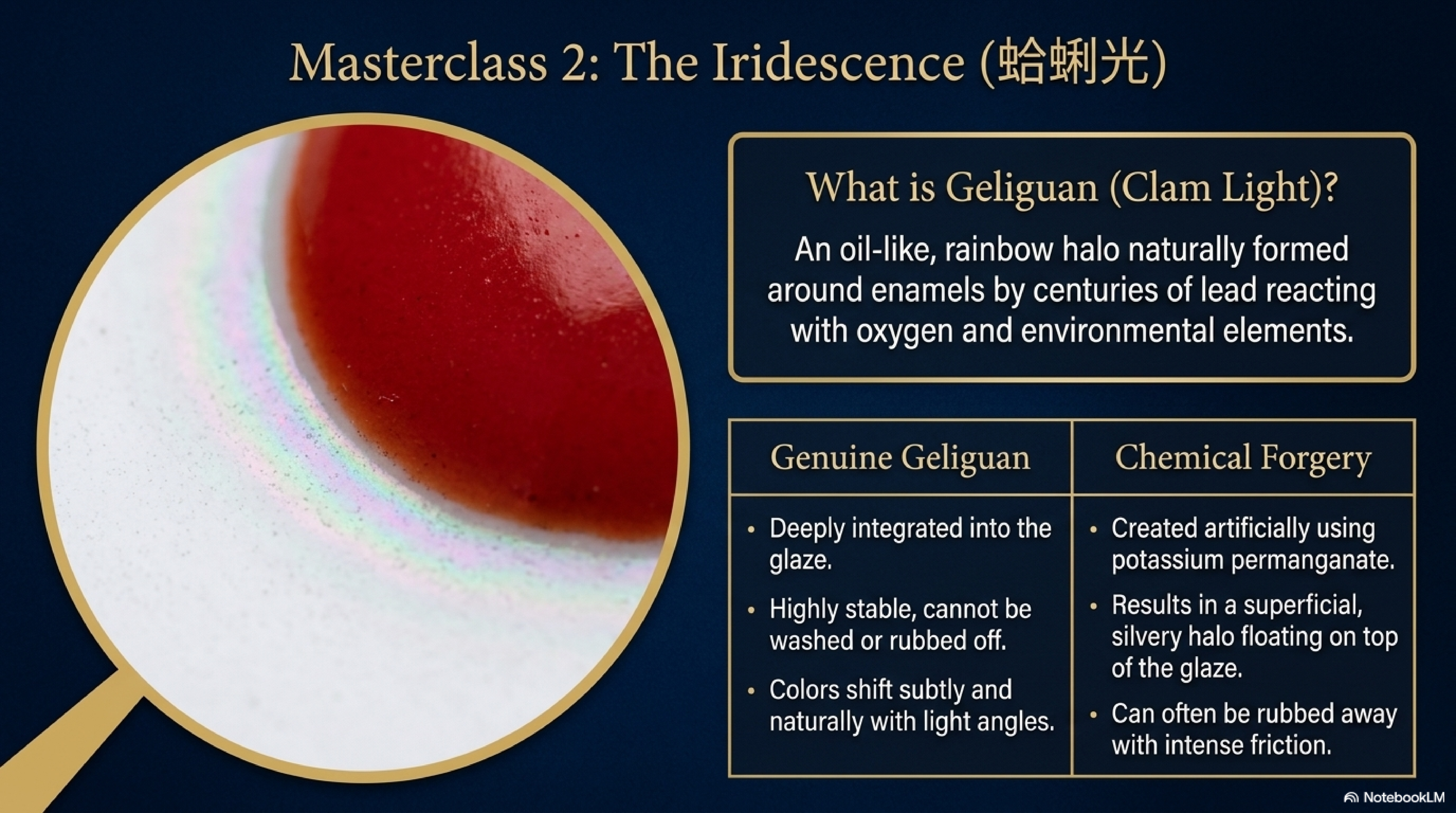
Masterclass — The Iridescence (蛤蜊光 Geliguan): magnified view of authentic aged overglaze enamel showing oil-like rainbow halo naturally formed by centuries of lead reacting with oxygen; genuine Geliguan (deeply integrated, colour-shifting, cannot be rubbed off) versus chemical forgery (superficial silvery halo, rubs away)
Masterclass 2: The Iridescence (蛤蜊光). On genuine aged Wucai, the overglaze enamel develops an oil-like, rainbow halo — the result of centuries of lead in the enamel reacting with oxygen and environmental elements. Genuine Geliguan is deeply integrated into the glaze: highly stable, cannot be washed or rubbed off, and its colours shift subtly and naturally with viewing angle. Chemical forgery creates a superficial, silvery halo floating on top of the glaze that can often be rubbed away with intense friction. This iridescence is visible at oblique angles on aged red and green enamel fields and is one of the most reliable authentication markers for Ming and Kangxi Wucai.

The Polychrome Divide: Structure vs. Colour Field

The most important conceptual distinction in Ming-Qing polychrome ceramics is the structural difference between Wucai and Doucai. Both use underglaze cobalt and overglaze polychrome enamels. The difference is not visible in the colour palette but in the compositional role of the cobalt — and that difference defines everything about how each tradition is painted, fired, and read.

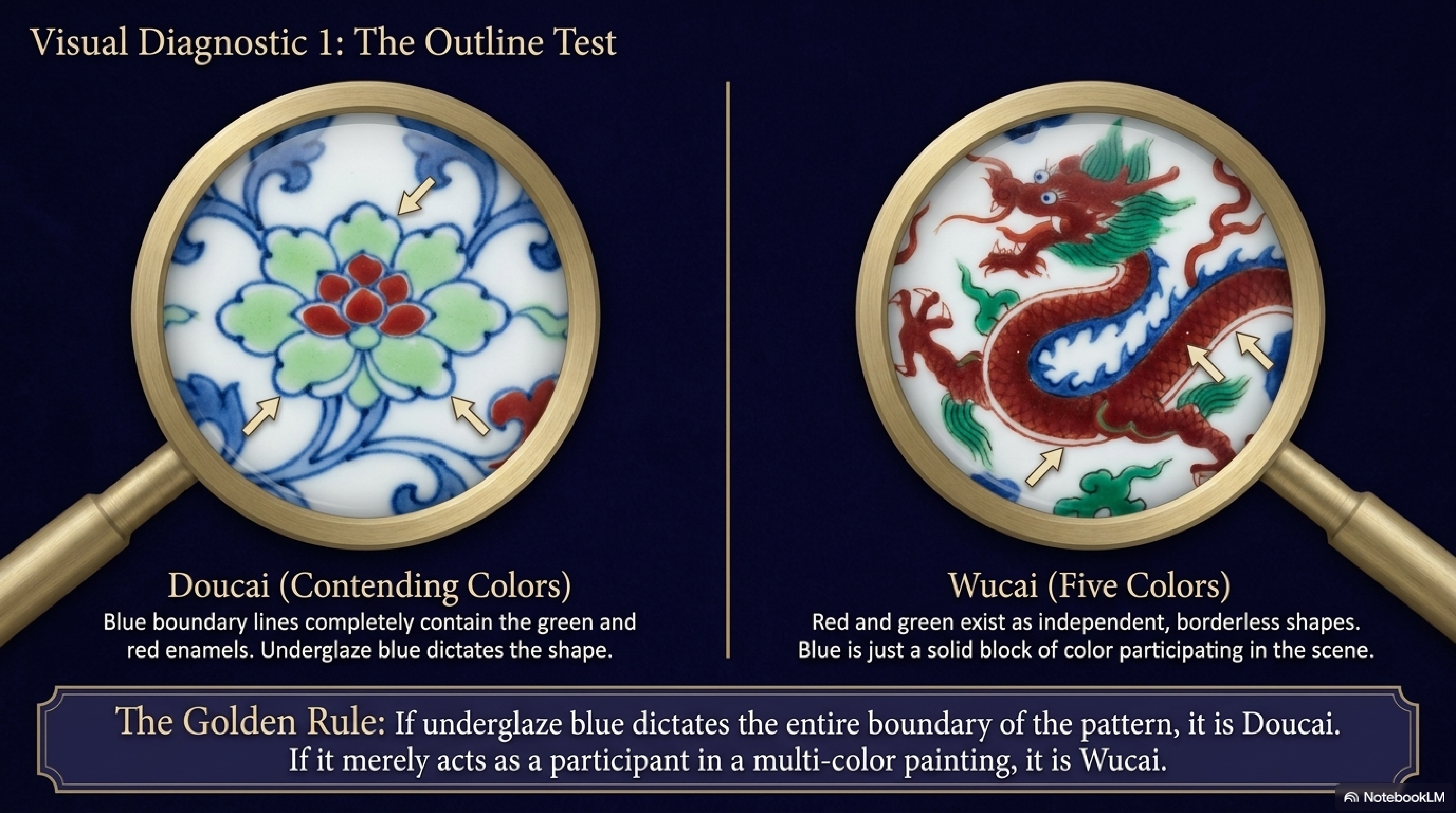
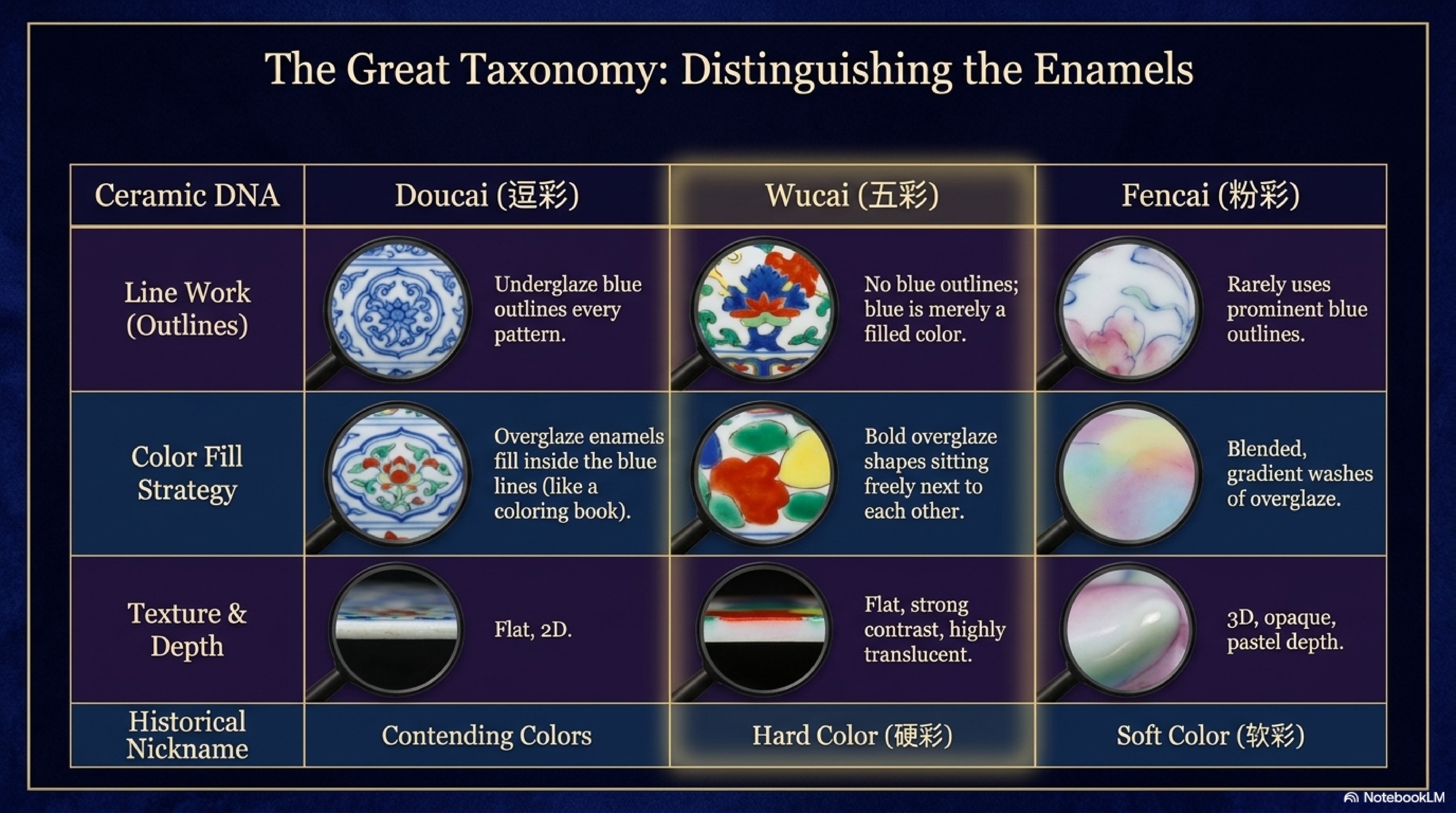
Visual Diagnostic — The Outline Test: magnifying glass comparison of Doucai (underglaze blue outlines completely contain green and red enamels, dictating every shape boundary) versus Wucai (red dragon and green cloud exist as independent borderless shapes, blue merely a solid colour participant)
The structural split — Visual Diagnostic 1: The Outline Test. Doucai (left): underglaze blue outlines completely contain the green and red enamels — the blue boundary lines dictate every shape; the overglaze enamels are fills within a pre-drawn framework. Remove the cobalt outline and the composition collapses. Wucai (right): red and green exist as independent, borderless shapes — blue is just a solid block of colour participating in the scene, one equal among others. The Golden Rule: if underglaze blue dictates the entire boundary of every pattern element, it is Doucai; if it merely acts as a participant in a multi-colour painting, it is Wucai.

五彩 Wucai

Cobalt role: One colour field among several — spatial element, not structural outline
Overglaze: Independent flat colour fields; may cover, border, or contrast freely
Palette logic: Bold colour contrast (硬彩) — saturation through juxtaposition
Key periods: Jiajing–Wanli Ming; Kangxi Qing
Diagnostic: Cobalt as colour zone = Wucai / 青花五彩

斗彩 Doucai

Cobalt role: Complete structural outline (完整轮廓线) — draws and contains the composition
Overglaze: Fills within cobalt-defined outlines; always bounded
Palette logic: Outline-and-fill — structure first, colour second
Key periods: Chenghua Ming (pinnacle); Yongzheng Qing (revival)
Diagnostic: Complete underglaze outline as drawing = Doucai

"五彩者,色各为主,斗彩者,青花为骨。"

In Wucai, each colour is sovereign — red commands its zone, green commands its zone, blue commands its zone, and the visual energy comes from their confrontation. In Doucai, the cobalt is the skeleton and the colours are its clothing — subordinate to the structure that the underglaze line defines. This difference in compositional philosophy is not merely technical; it is aesthetic, and it produces two entirely different ways of looking at polychrome porcelain.
The Great Taxonomy — Distinguishing the Three Great Overglaze Traditions: comparison table of Doucai (逗彩), Wucai (五彩), and Fencai (粉彩) across Line Work, Colour Fill Strategy, Texture and Depth, and Historical Nickname (Contending Colors / Hard Color 硬彩 / Soft Color 软彩)
The Great Taxonomy: Distinguishing the Enamels. Doucai (逗彩/斗彩): underglaze blue outlines every pattern element; overglaze enamels fill inside the lines; flat 2D texture; historical nickname "Contending Colors." Wucai (五彩): no blue outlines — blue is merely a filled colour; bold overglaze shapes sit freely next to each other; flat, strong contrast, highly translucent; historical nickname "Hard Color" (硬彩). Fencai (粉彩): rarely uses prominent blue outlines; blended gradient washes of overglaze colour; 3D, opaque, pastel depth; historical nickname "Soft Color" (软彩). Three traditions, one technical ancestor — differentiated by compositional logic and surface character.

Currently Available · 五彩在售

Selected Wucai & polychrome pieces available from our eBay store.

Outstanding Antique Chinese Famille Noire Tibetan-Ewer with lid, DUOMUHU, 19th C

黑地粉彩多穆壶带盖,19世纪

View on eBay →
Large Chinese famille verte plate Butterfly with Peony, Kangxi (1662–1722)

五彩蝴蝶牡丹大盘,康熙时期

View on eBay →
Antique Chinese Famille Noire 'Four Heavenly Kings' vase, 19th C (H: 28.2 cm)

黑地粉彩四大天王瓶,高28.2cm,19世纪

View on eBay →

All pieces ship from the United Kingdom.  ·  View all available pieces →